
Choosing the right Switch Terminal in 2026 is not merely a catalog exercise. It is a reliability decision made before the first wire is crimped. A terminal may look suitable on a clean workbench, yet fail after heat, vibration, moisture, and repeated switching. Elena Varga, a senior electrical interconnection engineer with 18 years of field experience, says, “A terminal is only as reliable as the environment it must survive.” That principle deserves attention.
The selection process should begin with the application, not the product photograph. Check rated current, operating voltage, contact resistance, wire range, insulation material, and temperature limits. Then examine mounting space, actuator travel, sealing performance, and expected service cycles. Small details matter. A loose fit can create heat. A thin plating layer can accelerate wear. Poor strain relief may damage the conductor near the terminal.
In 2026, buyers should also review traceability, test reports, and manufacturing consistency. Look for evidence of vibration testing, thermal cycling, and corrosion resistance. Ask whether the Switch Terminal matches the applicable industry requirements for its equipment. Certification alone is not a complete answer. It can confirm a baseline, but real performance depends on installation quality.
I have seen specifications overlooked.
That mistake is easy to repeat. A practical choice balances electrical performance, mechanical strength, safety, availability, and total cost. The cheapest terminal may become the most expensive component after rework. There is no perfect selection. Careful engineers still revisit their assumptions, especially when conditions change.
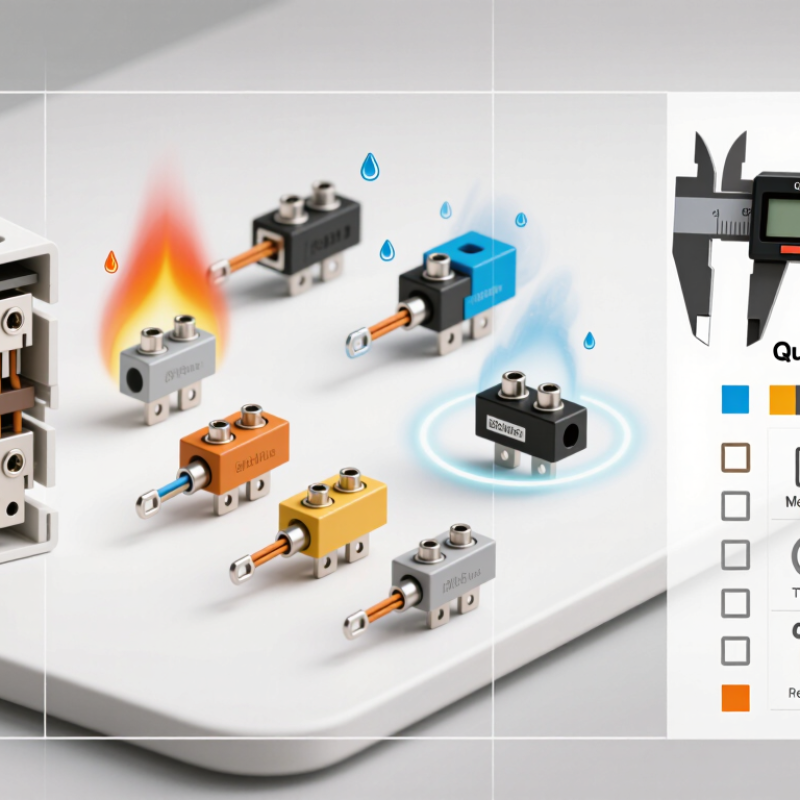
Choose the terminal by circuit load, not appearance. Resistive heaters need stable current capacity. Motors create higher starting current and electrical arcing. Coils and solenoids can produce voltage spikes. Capacitive loads may create brief inrush currents. A terminal rated for 10 A resistive duty may fail under repeated motor switching. IEC 60947-1:2020 provides general rules for low-voltage switchgear, including equipment up to 1,000 V AC or 1,500 V DC. It does not replace application testing. Check the product’s utilization category and switching frequency.
Voltage selection also needs practical margin. Confirm the working voltage, insulation voltage, impulse withstand voltage, and pollution environment. For control circuits, IEC 60947-5-1 categories such as AC-15 and DC-13 help describe electromagnetic loads. The International Energy Agency reported that global electricity demand rose by about 2.2% in 2023, with further growth expected from electrification and data services. More compact systems may carry higher currents in tighter spaces. Heat deserves attention. It is easy to underestimate.
Tips: Record load type, nominal current, inrush current, voltage, duty cycle, and ambient temperature. Then compare them with IEC test ratings, conductor size, and terminal spacing. Leave realistic headroom, but avoid choosing blindly oversized parts. A larger terminal can still be unsuitable. Recheck connections after thermal cycling. Field conditions often expose assumptions that laboratory labels cannot.
Terminal selection starts with heat, not appearance. Copper offers about 1.68 × 10⁻⁸ Ω·m resistivity at 20°C, according to NIST reference data. Brass is higher, so its resistance and heat rise can increase under the same load. At 10 A, a 20 mΩ contact produces 2 W. That heat may become serious inside a sealed switch. The 2024 IEC 60512 connector test framework emphasizes temperature-rise testing, contact resistance, and mechanical reliability. Use measured data, not only catalogue current ratings.
A 105°C insulation limit is a boundary, not a target. Add ambient temperature, terminal heating, nearby wire heating, and enclosure effects. For example, at 70°C ambient, only 35°C remains before reaching 105°C. Plated copper terminals may support lower resistance and better corrosion control, while unplated brass can suit moderate loads. Yet plating thickness, crimp quality, and contact force can matter more than base material. This is where practical testing often disagrees with a neat spreadsheet.
Tips: Check resistance after crimping, then test at the real current. Record terminal temperature at the hottest point. Leave margin below 105°C. A 105°C-rated wire does not make every terminal safe at 105°C. I still allow extra margin, because installation errors happen. Reference IEC 60512 test methods, NIST material data, and the insulation manufacturer’s temperature rating before approval.
How to Choose the Right Switch Terminal in 2026?
Select IP Protection Levels from IP20 to IP67 for Installation Conditions
Choosing a switch terminal starts with its installation environment, not its appearance. An IP20 terminal suits clean, dry control cabinets with no water exposure. Its first digit protects against solid objects larger than 12.5 millimeters, but it does not resist moisture. Keep it indoors.
For workshops, utility rooms, or covered outdoor panels, IP44 or IP54 may offer better protection. IP44 handles splashing water, while IP54 limits dust entry and resists water splashes. However, “splash-resistant” does not mean weatherproof. I have seen terminals fail because condensation entered through an unsealed cable opening.
Wet or dusty locations often require IP65 or IP66. IP65 is dust-tight and withstands water jets. IP66 tolerates stronger water jets, which can matter during equipment cleaning. IP67 allows temporary immersion, commonly up to one meter for 30 minutes under IEC 60529 test conditions. It is useful near washdown zones, but immersion testing does not guarantee protection against chemicals, salt, ultraviolet exposure, or repeated impact.
Installation details still matter. Use compatible cable glands, tighten covers evenly, and inspect seals for cuts or compression damage. A certified enclosure can lose its rating after careless assembly. This is the part many selection guides understate. Check temperature, vibration, drainage, and maintenance access before choosing the terminal. Higher IP protection is not automatically better; it can complicate heat dissipation and servicing.
Practical IP-code guidance for selecting switch terminals, terminal enclosures, and associated connection assemblies according to installation conditions.
| IP Rating | Solid-Object Protection | Water Protection | Typical Installation Conditions | Suitable Terminal or Switch Applications | Selection Notes |
|---|---|---|---|---|---|
| IP20 | Protected against solid objects larger than 12.5 mm, including accidental finger access. | No protection against water. | Clean, dry indoor locations inside a suitable enclosure or control cabinet. | Indoor switch terminals, distribution boards, control panels, and protected equipment rooms. | Use only where moisture, dust, and direct contact are controlled by the installation environment. |
| IP30 | Protected against solid objects larger than 2.5 mm, such as tools and small wires. | No protection against water. | Dry indoor areas where smaller objects may be present but water exposure is not expected. | Enclosed switchgear, indoor automation panels, and protected terminal compartments. | Not appropriate for condensation, washdown, outdoor exposure, or dusty processes. |
| IP40 | Protected against solid objects larger than 1 mm, including most small tools and wires. | No protection against water. | Dry indoor installations with a higher risk of small-object entry. | Indoor terminal boxes and switch assemblies in workshops, machinery interiors, and electrical rooms. | Provides better object protection than IP30, but it does not address dust sealing or moisture. |
| IP44 | Protected against solid objects larger than 1 mm. | Protected against water splashes from all directions. | Sheltered outdoor areas, utility spaces, and indoor locations exposed to occasional splashing. | Basic outdoor switch terminals, sheltered junction boxes, and service-area controls. | Not dust-tight and not intended for water jets, immersion, or heavy outdoor contamination. |
| IP54 | Dust-protected; limited dust ingress is permitted, but it must not interfere with operation or safety. | Protected against water splashes from all directions. | Moderately dusty indoor or outdoor locations with occasional splash exposure. | Industrial switch terminals, machinery control boxes, workshops, and covered outdoor equipment. | A practical general-purpose level where complete dust sealing and hose-down resistance are not required. |
| IP55 | Dust-protected with limited ingress that must not affect safe operation. | Protected against water jets from any direction. | Dusty industrial areas and locations subject to rain or moderate cleaning spray. | Outdoor switch enclosures, production machinery, process equipment, and covered washdown zones. | Verify that cable glands, covers, seals, and terminal entries maintain the same protection level. |
| IP65 | Dust-tight; no dust ingress is permitted during the specified test. | Protected against water jets from any direction. | Heavy dust, rain, outdoor exposure, and routine low-pressure cleaning. | Sealed switch terminals, industrial control boxes, outdoor machinery, and dusty process areas. | A strong choice for dusty or wet locations when temporary immersion is not expected. |
| IP66 | Dust-tight; no dust ingress is permitted during the specified test. | Protected against powerful water jets from any direction. | Severe outdoor weather, strong spray, and intensive cleaning conditions. | Outdoor switchgear, heavy industrial equipment, vehicle-related systems, and washdown areas. | Choose when high-pressure or powerful water jets are possible; check pressure and duration requirements. |
| IP67 | Dust-tight; no dust ingress is permitted during the specified test. | Protected against temporary immersion in water under the specified test conditions, commonly up to 1 m for up to 30 minutes. | Locations where equipment may be temporarily flooded, dropped into water, or exposed to standing water. | Sealed switch terminals, outdoor equipment near ground level, drainage areas, and mobile machinery. | IP67 immersion protection does not automatically include protection against powerful water jets; IP66/IP67 may be required. |
How to Choose the Right Switch Terminal in 2026?
Start with the insulation, not the catalog photo.
A UL 94 V-0 rating means each vertical specimen stops burning within 10 seconds after ignition. Total afterflame time must remain within the standard’s limit. Flaming drips must not ignite the cotton indicator. Check the tested thickness. A thinner terminal wall may not achieve the same result.
A terminal also needs verified 4 kV surge resistance for its actual circuit. Ask for the impulse waveform, polarity, repetition count, and test points. Line-to-line testing differs from line-to-earth testing. Creepage distance, clearance, pollution level, and material CTI can change the result. IEC 60664-1 provides the insulation-coordination framework, but 4 kV is not automatically suitable for every installation. It depends on the overvoltage category and system design.
Heat matters too. A terminal can pass a plastic flame test, then fail during repeated high-current switching. Measure contact temperature after cycling, not only during a short laboratory test. The National Fire Protection Association reported 32,950 U.S. home fires involving electrical distribution and lighting equipment from 2015 to 2019. Those fires caused about 470 civilian deaths and $1.3 billion in direct property damage. That data makes verification practical, not decorative. I would also recheck supplier test reports yearly. Documents can remain valid while materials, tooling, or wire combinations quietly change.
How to Choose the Right Switch Terminal in 2026?
A 10,000-cycle rating measures repeated operation, not every terminal connection. This distinction matters. A screw terminal can remain electrically stable through 10,000 switch cycles when tightened correctly. However, vibration may loosen the screw over time. Periodic torque checks may be necessary in mobile equipment.
Spring-clamp terminals usually resist loosening better. They maintain contact pressure during vibration and temperature changes. Maintenance is simpler, but damaged springs require terminal replacement. Push-in terminals install quickly and suit controlled environments. Their performance can decline when wires are inserted unevenly or exposed to repeated pulling. Soldered connections offer strong electrical continuity, yet repairs take longer and require careful heat control.
In practical testing, compare terminals under the same load, wire size, humidity, and vibration. Record contact resistance before cycling, during cycling, and after 10,000 operations. Look for heat marks, loose conductors, and intermittent signals. Small details matter. I once focused only on cycle counts and overlooked conductor movement. That was a poor assumption. A terminal with a high rating may still fail early if installation quality is inconsistent.
Choose screw connections when adjustability matters. Choose spring clamps when vibration and low maintenance are priorities. Use push-in designs for speed, after verifying wire retention. Check the manufacturer’s technical data, installation limits, and inspection guidance before final selection.
1901 West Main Street
Washington, MO 63090
Main Directory: 1-800-227-4873
Email: sale@pangcofurniture.com

We’re always looking for talented individuals to join our team. Send us your resume using the form below. When a position comes available that matches your skillset, one of our team members will reach out to you.
"*" indicates required fields